At Isilimela Hospital, outside Port St. Johns in the rural Eastern Cape, families often travel an hour or more by taxi to access occupational and speech therapy. Literacy rates in the surrounding area are extremely low.
“We have kids coming in who are 16 years old, and they’re only in grade 6,” says Nic Engelbrecht, a community service speech therapist at the hospital. “They don’t know their letters. They don’t know how to write their own name.”
Faced with this reality, the Isilimela rehabilitation department set out to infuse books across all of its programmes: from speech and occupational therapy, where they see 85 to 100 children each month, to physiotherapy and the paediatric ward, where children confined to beds need stimulation. In 2021, the team reached out to Book Dash to become a distribution partner, and has received more than 4,000 books to date.
“Our goal is to give every child that comes into our department Book Dash books,” Engelbrecht says. “We encourage literacy in every way.”
Books help children relax and feel comfortable in therapy sessions, says Cari Steenkamp, an occupational therapist at the hospital. “Incorporating these books into treatment sessions really helps to bridge that ‘patient-therapist’ barrier, easing the child into a trusted safe space where interaction flows more naturally.”
Many children who visit the therapy team have autism spectrum disorder (ASD) or intellectual disabilities (ID). For these children, books are not just about reading: they help caregivers communicate with children who struggle to regulate their emotions and express themselves; support skills like joint attention, sequencing, choice-making and turn-taking; and help establish routines, which are particularly challenging for children with ASD and ID.
“We use books as a way to get children to go to bed,” says Engelbrecht. “They know it’s reading time, and it’s bedtime straight after that.”
Members of the rehabilitation team teach caregivers how to read with their children, which isn’t always about “reading” in the traditional sense: they focus on pointing, following the child’s lead, asking questions, and if the child can’t respond, answering the questions.

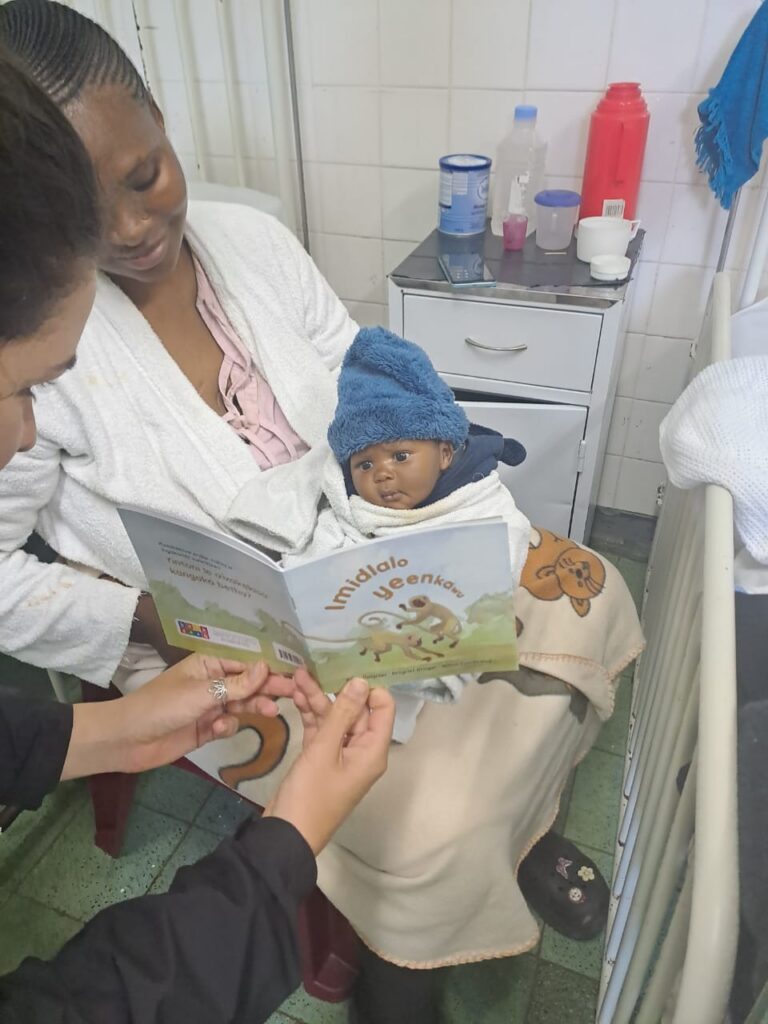
Book Dash titles have proved particularly well-suited to the work and the context. Lefa’s Bath is easily relatable because it centres on a familiar daily routine, and features animals who make sounds that even non-verbal children can imitate. Because it is a wordless book, caregivers of any literacy level can describe scenes, point out details and make up their own story.
Utata Ufika Ekhaya (in English, Tata Comes Home) also resonates deeply, as many children who visit the hospital are away from one or both parents for extended periods. The book focuses on the joy of togetherness, rather than the absence.
Receiving books in isiXhosa is particularly impactful. “The isiXhosa books are the gold,” says Engelbrecht. “It’s so much better for literacy because most of the schools are Xhosa-based.”
Isilimela gives children books to take home across its programmes – an anomaly in a community with low rates of book ownership. Caregivers have shared the difference it makes.
One grandmother who once watched her grandchild tear paper now reads with him daily, as he sits calmly, points to pictures and engages. Books are often shared with siblings, and English titles give older children extra reading practice.
The Isilimela team wants to do even more. Inspired by another rural Eastern Cape hospital in Madwaleni, Isilimela launched a new library in March; all team members are trained to issue books to ensure maximum reach. “The children we see really enjoy choosing their books – it gives them great autonomy,” says Steenkamp. In the future, the Isilimela team also plans to train nearby early childhood development centres on practical strategies for early literacy development.
For Engelbrecht, a passionate reader herself, the mission runs deeper than therapeutic goals and skill-building. “Books aren’t just education,” she says. “I want kids to be able to read the books I read – maybe not the same books, but to have that ability to access that magic.”
Her message to other healthcare providers? Integrating books into rural healthcare is simple – and it has enormous benefits. “Books are really easy. You can get a book, sit down with a child, and show them pictures. It doesn’t matter what language the book is – you can still have fun with it, you can still make a story.”